The Coat of Arms of Trinidad and Tobago was designed by a committee formed in 1962 to select symbols that would be representative of the people of Trinidad and Tobago. The committee included noted artist Carlisle Chang and Carnival designer, the late George Bailey.
The Coat of Arms, together with the accompanying motifs representing indigenous features of Trinidad and Tobago, was selected and formally agreed for use in 1962, in a design approved by the College of Arms.
Symbolism of the Coat of Arms
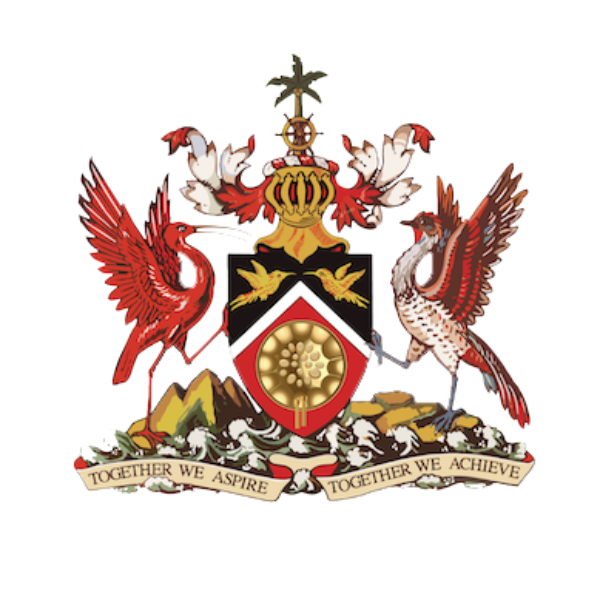
The birds represented on either side of the Coat of Arms are the Scarlet Ibis and the Cocrico, which is native to Tobago. Both are shown in their natural colours.
The three peaks were principal motifs of Trinidad’s early British Colonial Seals and Flag-Badges. They commemorated both Columbus’ decision to name Trinidad after the Blessed Trinity and the three peaks of the southern mountain range, called the “Three Sisters,” which a sailor on Columbus’ flagship saw on the horizon.
The fruited Coconut Palm dates back to the great seals of British Colonial Tobago in the days when the island was a separate administrative unit.
The national motto, “Together we aspire, Together we achieve”, promotes harmony in diversity for national achievement.
Use of the Coat of Arms
The Coat of Arms is the seal of state of the Government and is arguably the most important of the National Emblems. It is located at the top of all government documents.
A licence must be acquired to reproduce and sell the Coat of Arms.
The Coat of Arms can only be displayed in full colour, with all colours consistent, or in gold, silver, bronze, or black and white.