
NO NEW TARIFFS ON EXPORTS FROM TRINIDAD AND TOBAGO: ACTIONS OF KAMLA PERSAD-BISSESSAR GOVERNMENT HAS LOWERED TARIFFS FROM 15% TO 10% ON EXPORTS FROM TRINIDAD AND TOBAGO TO THE UNITED STATES OF AMERICA
The Ministry of Foreign and CARICOM Affairs has noted the misleading and outright inaccurate reporting in today’s Guardian Newspaper with the Headline “US Slaps T&T with 10% Tariff.” This front-page story demonstrates the absence of diligent, intelligent and responsible journalism, which can mislead members of the business community and other commentators.
The Ministry of Foreign and CARICOM Affairs wishes to categorically state that the United States of America has not applied any new tariffs on exports from Trinidad and Tobago.
Members of the public may recall that via Executive Order 14326 of 31 July 20251 United States President Donald Trump unveiled new reciprocal tariffs on more than seventy (70) countries globally, including Trinidad and Tobago. The decision was a follow-up to Executive Order 14257 dated 02 April 2025 (Regulating Imports with a Reciprocal Tariff to Rectify Trade Practices that contribute to large and persistent annual United States Goods Trade Deficits). The new tariffs came into effect on 07 August 2025. At that time, a reciprocal 15% tariff rate was applied on Trinidad and Tobago’s exports to the USA. This was the applied tariff rate inherited by the current Government of Trinidad and Tobago.
In February 2026, the United States Supreme Court2 reversed the US Administration’s reciprocal tariffs which were imposed under the International Emergency Economic Powers Act. Immediately after the ruling, the US President exercised powers under Section 122 of the US Trade Act and imposed a 10% temporary tariff on all countries globally.3 This global tariff expired at midnight on 24 July 2026.
Further, on 12 March 2026, the United States of America initiated a Section 301 investigation into sixty (60) of its largest trading partners. These countries were investigated for their acts, policies, and practices related to the failure to impose and effectively enforce a ban on the importation of goods produced with forced labour. Section 301 of the United States Trade Act of 1974 allows the U.S. to investigate and respond to foreign trade practices that are unfair, discriminatory, or burden U.S. commerce. While the investigation was not specifically targeted at Trinidad and Tobago, the country was required to participate in the investigation as it falls within the top 60 of the United States’ trading partners.
On June 2, 2026, the USTR determined that the acts, policies, and practices of each of its sixty (60) top trading partners economies were unreasonable and proposed to determine in each investigation that action is appropriate under section 301 to obtain the elimination of the actionable acts, policies, and practices, including imposing ad valorem tariffs on all goods of each investigated economy, with exemptions for certain goods. The USTR further proposed to impose a tariff of up to 12.5% on each country under investigation. Specifically, on June 02, 2026, the USTR proposed to apply a 12.5% tariff4 on exports from Trinidad and Tobago in addition to 59 other countries which comprised the USA’s top 60 trading partners. The USTR subsequently invited comments by interested persons on its proposed actions and convened public hearings during the period July 07-09, 2026.
The public is once more informed that under the direction and leadership of the Honourable Prime Minister Kamla Persad-Bissessar, the Government of Trinidad and Tobago took immediate steps to ensure that the 12.5% proposed tariffs on Trinidad and Tobago’s exports to the USA were not applied.
Specifically, the Honourable Prime Minister instructed that legislation be brought to the Parliament to prohibit the importation of goods produced from forced labour into Trinidad and Tobago.
This was undertaken via Act No. 16 of 2026 (assented to on 25th June 2026), which codified an Amendment to section 45 of the Customs Act. This legislation was piloted by the Honourable Davendranath Tancoo, Minister of Finance.
In addition, the Honourable Sean Sobers and a team from the Ministry of Foreign and CARICOM Affairs participated in highly technical discussions with the United States Trade Representative (USTR) during the period May-July 2026, including in-person visits to the Office of the USTR in Washington, DC on 14 May 2026 and 16 July 2026.
On 23 July 2026, the President of the United States of America announced the following:
(i) the USTR shall impose a tariff rate of 10 percent on all goods of Argentina, Bangladesh, Cambodia, Canada, Ecuador, El Salvador, Guatemala, Honduras, India, Indonesia, Jordan, Malaysia, Mexico, Pakistan, Sri Lanka, the United Kingdom, and Trinidad and Tobago.
(ii) the USTR shall impose a tariff rate of 10 percent or 12.5 percent on certain products from Japan, Korea, and Switzerland.
(iii) the USTR shall impose a Tariff rate of 12.5 percent on all goods of all other investigated economies below:
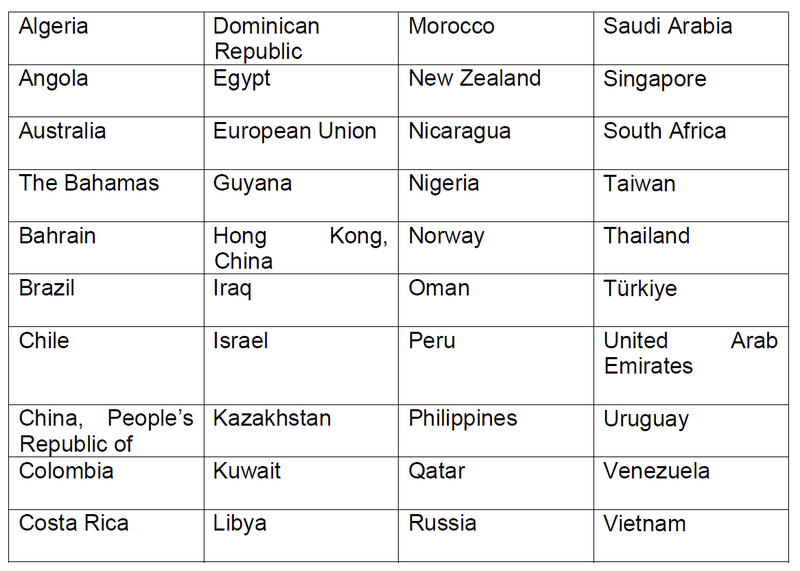
The decision to apply the lowest rate of 10% to certain economies, such as Trinidad and Tobago, was based on action taken by countries to impose prohibitions on the importation of goods produced from forced labour. This information is clearly contained in paragraph nine of the Announcement of President Trump issued on 23 July 20265 which states “ Finally, the Trade Representative has informed me that following consultation with certain economies in these investigations and publication of the Notice of Determinations, additional economies have imposed forced labour import prohibitions (Cambodia, Guatemala, Honduras, India, Sri Lanka, and Trinidad and Tobago) or undertaken commitments regarding forced labour import prohibitions in an Agreement on Reciprocal Trade (Jordan). As a result of these actions, the Trade Representative has advised me that the goods of these economies should be tariffed at the 10 percent rate to encourage these economies further to enforce such prohibitions effectively, and, in the case of Jordan, to enact and effectively enforce its commitments regarding forced labour import prohibitions.”
The public is also reminded that the United States Trade Representative has agreed to maintain the exemptions from the above tariffs, for certain products from Trinidad and Tobago and the rest of the world including:
HS27090010-Crude Petroleum
HS28141000-Anhydrous Ammonia
HS 31028000-Urea, Ammonium Mixtures in Solution
HS27111100-Liquefied Natural Gas
HS31021000-Urea
HS72031000 Ferrous Products From Iron Ore Reduction [Iron pellets]
Collectively, these products constitute over 85% of Trinidad and Tobago exports to the USA, which will attract a duty rate of 0%.
In light of the above, the Government of Trinidad and Tobago wishes to clarify that Trinidad and Tobago has not been subjected to a 12.5 percent tariff by the United States. On the contrary, following sustained engagement and proactive measures by the Government, Trinidad and Tobago has successfully secured a reduction in the tariff rate applicable to its exports to the United States, from 15 percent in August 2025 to the lowest applicable rate of 10 percent.
The Government of Trinidad and Tobago is thankful for the positive feedback received from the business community for its proactive actions, including from the Trinidad and Tobago Manufacturers Association, Trinidad and Tobago Chamber of Industry and Commerce and the American Chamber of Industry and Commerce.
Members of the Media are invited to familiarise themselves with the contents of the above and consult with informed professionals when publishing stories relating to the above matters.
2 https://www.govinfo.gov/content/pkg/FR-2026-06-05/pdf/2026-11296.pdf
4 https://www.govinfo.gov/content/pkg/FR-2026-06-05/pdf/2026-11296.pdf
